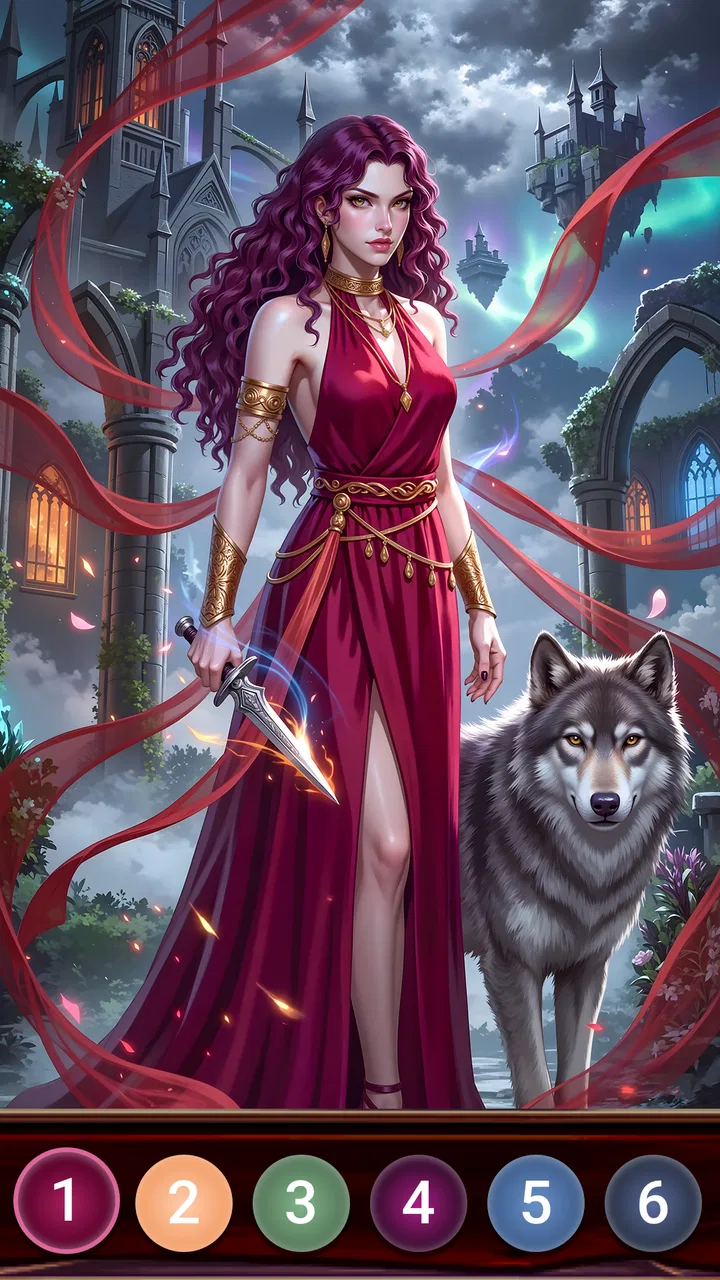
Dark Night Paint by Numbers
- 4.6
- Rating
- 500.00K
- Installs
- Free
- Price

 Analysis by App-foxy
Dark Night Paint by Numbers is the kind of board game I open when I want something quiet, visual, and easy to understand without feeling completely empty. Its basic idea is simple: I choose a dark-themed picture, match numbered areas with their colors, and gradually turn a shadowy scene into a finished illustration. That familiar format makes it approachable, but the nighttime presentation gives it a more focused identity than a bright, cheerful coloring app.
After spending time with it, my impression is that the game works best as a short reset between other tasks. I do not approach it as a competitive challenge or a deep strategy board game. I use it to slow down, concentrate on small details, and enjoy the change from a mostly monochrome image to a completed scene. The transformation is the main reward, and the game understands that its audience is probably looking for a calm activity rather than pressure.
BrainArt Studio presents this as a free game in the board category, with an Everyone age rating. It has reached over one hundred thousand installs and holds a 4.7 average from around 2.9 thousand ratings, which suggests that the straightforward coloring loop is connecting with a sizeable audience. The app was released on January 17, 2025, and the current version is 1.3.6. It runs on Android 7.0 or later, so it is accessible on many older devices as well as newer phones.
You May Also Like

 Blood Strike: 2.5 Anniversary
Blood Strike’s Loadouts Turn Every Drop Into a Tactical Gamble
A close look at Blood Strike’s custom loadouts: how fast access to signature weapons reshapes its battle royale rhythm, rewards preparation, and narrows the gap between fights.

 Pandora - Music & Podcasts
Pandora’s Music Is Easy to Start, but Harder to Recover
Pandora’s strength is its low-effort path from a seed to a station. Its weak spot is how much confidence it asks you to place in connection, setup, and quiet recovery.

 8 Ball Pool
 Is Built on Rivalries, Rematches, and Routine
A close look at the rivalries, rematches, shared routines, and unanswered safety questions that turn a quick pool match into a persistent mobile community.

 Samsung Music
’s Quiet Strength Is Playing What You Already Own
Its reach comes less from spectacle than from dependable access to a personal library. That simplicity is both the app’s strongest retention engine and its ceiling.

 AccuWeather: Weather Radar
AccuWeather Review: A Quick, Clear Forecast for Everyday Decisions
For everyday plans, the best forecast is the one you can understand quickly. AccuWeather makes rain timing, radar, and local conditions easy to act on, with a few trade-offs.

 Hill Climb Racing
Why Hill Climb Racing Still Turns Crashes Into One More Run
A tiny car, a bumpy hill and one more upgrade: Hill Climb Racing keeps resurfacing because its simple chaos makes every near-miss feel personal.
More From Our News Desk



A quiet painting game built around darkness and transformation
I find the appeal here less about coloring quickly and more about watching a subdued scene become legible one small area at a time. That makes the game a natural fit for brief, low-pressure sessions, though it also sets a clear limit: its pleasure depends on enjoying guided repetition rather than making your own picture. I’d keep that distinction in mind as I look at what the dark visual style adds.
The first few minutes feel clear and welcoming
The strongest part of my first impression is how quickly the purpose becomes obvious. There is no need to learn a complicated rule set, memorize combinations, or understand a long progression system before starting. The numbered coloring format gives me an immediate task: identify an area, find its matching color, and fill it. That clarity matters on a phone, where I may be playing with one hand while waiting for a bus or taking a short break.
The dark visual direction also changes how the familiar format feels. In many coloring games, the appeal comes from bright designs and cheerful palettes. Here, the starting images lean into mystery and nighttime mood. The unfinished picture feels intentionally subdued rather than merely incomplete, and each colored section appears to reveal more of the scene. I found that this made the act of finishing an image feel more like uncovering it than simply decorating it.
The game is free to start, which makes it easy to try without making a commitment. There are in-app purchases ranging from $0.99 to $39.99 per item, so I would recommend paying attention to the purchase flow if you are handing the phone to a child or prefer to keep all optional spending disabled. The Everyone rating makes the game broadly suitable, but an age rating does not replace sensible device-level purchase controls.
One practical strength is that the central activity does not demand a large time block. I can color a few areas and stop, then return later without needing to remember a complicated position. That makes it more convenient than a traditional board game when I only have a few spare minutes. It also makes it less satisfying for someone who wants a strong sense of competition, discovery, or narrative progress.
The visual language does more than decorate the board
The setting is communicated through contrast. Dark backgrounds and mysterious scenes establish the tone before I have done much at all, while the selected colors gradually bring the image forward. This creates a useful visual relationship between the board and the action: the picture begins quiet and concealed, then becomes more legible as I work through it.
I particularly like the way this approach gives small color choices more weight. In a very bright coloring game, one completed section can disappear into an already busy image. In a dark scene, each new patch tends to feel noticeable. That does not turn the game into a story-driven experience, but it gives the otherwise repetitive matching process a clear visual purpose.
The artwork is best understood as atmospheric rather than realistic. I would not choose this game if I wanted precise digital painting tools, custom brushes, or complete control over every shade. The numbered format decides the structure for me. Its pleasure comes from following that structure and watching a prepared composition emerge, not from making an original illustration from a blank canvas.
This distinction is important when comparing it with ordinary coloring books on a phone. A traditional digital coloring app may offer more freedom, while a drawing app may let me create something entirely personal. Dark Night Paint by Numbers is more guided. That limitation is also why it feels relaxing: I spend less energy deciding what to do and more energy completing the next small step.
How I use the dark scenes without rushing them
My most effective habit is to avoid treating every image as a race to completion. I start by looking over the whole picture and noticing which areas are easy to identify. Large sections are useful when I want quick progress, while tiny sections work better when I need to settle my attention. Switching between those two types prevents the session from feeling like a long, uniform list of taps.
A second useful approach is to use the darker parts as visual anchors. Instead of filling areas randomly, I work around a recognizable object or silhouette and let the surrounding colors clarify it. This makes the image easier to read as it develops. It is a small change in workflow, but it gives the session more shape than simply chasing the next highlighted number.
I also find the game more comfortable when I play with the screen brightness set to a level that preserves the dark tones without making the details hard to see. The mood depends on shadow, yet overly dim settings can make small numbered spaces tiring to inspect. That is a trade-off created by the art direction itself: the same darkness that makes the scenes distinctive can require a little more visual attention.
Sound and rhythm support the intended mood
The pacing is gentle because the game does not need fast reactions. My attention moves in a repeating rhythm: locate a number, select the matching color, fill a section, and reassess the image. That loop is predictable, but the changing picture keeps it from feeling entirely mechanical. The rhythm is closer to sorting or arranging than to action gameplay.
This makes it a good companion for quiet moments. I can play while listening to something else, provided I do not need constant attention from the other activity. The game itself does not need to dominate the room. Its visual changes provide enough feedback to keep me engaged, while the lack of urgency lets me pause whenever I want.
The atmosphere works best when I allow the slower pace to remain slow. Trying to complete a picture as quickly as possible removes some of the reason to choose a dark, contemplative coloring game in the first place. I would not recommend it to someone who expects energetic sound design, rapid rewards, or a strong beat driving every move. Its appeal is the opposite: a controlled pace with a soft sense of progress.
There is also a useful psychological rhythm in the way unfinished areas remain visible. Even when I stop midway, the image shows exactly what has changed and what remains. That makes returning straightforward. I do not need a detailed explanation of my previous session; the picture itself acts as a reminder. For a casual game, that visual continuity is more useful than a complicated progress screen would be.
Where the mechanics fit and where they feel limited
The numbered coloring mechanic fits the theme because it turns darkness into a gradual reveal. Every correct selection has two effects: it completes a small mechanical task and improves the atmosphere of the image. That connection is the game’s clearest design success. The board is not merely a container for the mechanics; the mechanics are what bring the board’s mood into view.
At the same time, the underlying interaction remains repetitive. Once I understand the matching process, there is little strategic uncertainty. I am not weighing different moves or solving a difficult board position. The challenge is mostly visual attention and persistence. That can be exactly what I want after a busy day, but it may feel too passive if I am looking for a game that tests planning or rewards experimentation.
Small areas can also change the experience. Filling a broad region feels satisfying and efficient, while working through tiny pieces can slow the session considerably. I see this as both a strength and a weakness. Those details help the finished picture look more complete, but they can make the final stretch feel like careful cleanup rather than discovery. When I notice that happening, I take a break instead of forcing myself to finish immediately.
Another trade-off is the balance between guidance and freedom. The numbers remove uncertainty, which is helpful for relaxing play and for younger users. However, they also mean that the final color arrangement is largely predetermined. If I want to experiment with unusual palettes or reinterpret an image, this is not the right tool. A freeform coloring app would serve that purpose better.
The game is also less suitable for people who want social interaction. Its core pleasure is personal concentration, not conversation, competition, or collaboration. I can imagine sharing a finished image with someone, but the activity itself is primarily solitary. That is worth considering before downloading it as a family game or expecting it to replace a multiplayer board title.
Everyday situations where it makes sense
One realistic use is a ten-minute evening break after work. I can sit down, choose a partly completed dark scene, and fill enough sections to create visible progress without committing to a full gaming session. The low pressure helps me switch attention away from messages and unfinished tasks. Because the image remains recognizable while incomplete, stopping does not feel like abandoning a match.
It can also work during travel or waiting periods, especially for someone who prefers a quiet phone activity over scrolling through social feeds. The board format gives the hands a simple job, while the mysterious artwork provides more visual interest than a plain puzzle grid. I would still keep the device charged and use the game in a comfortable position, since repeated small taps can become tiring if I play for a long stretch.
For children, the Everyone rating and simple matching idea make the game approachable, but I would introduce it with clear expectations. It is a coloring activity with a guided system, not an open drawing studio. Adults may enjoy it for the same reason: there is a defined solution, so the user can focus on completion rather than artistic confidence.
For older players or anyone who finds detailed visual tasks calming, the game’s strongest use may be as a concentration exercise. I would not describe it as a formal cognitive tool, but it does encourage sustained attention to numbers, colors, and small spaces. The benefit comes from the act of focusing, not from a separate educational system.
How it compares with familiar alternatives
Compared with a conventional digital coloring book, this game offers less creative control but a clearer route to completion. I do not have to decide which colors might work or worry about making an image look balanced. That makes it friendlier when I want a dependable, low-effort activity. The cost is that my finished result reflects the game’s design more than my own artistic choices.
Compared with a standard puzzle game, it provides less problem-solving depth but a stronger sense of visual transformation. A logic puzzle may give me a more demanding mental workout, while this game gives me a calmer sequence of small successes. If I am tired, I prefer the coloring format; if I want to test a plan or chase a high score, I would choose something else.
It also differs from a traditional board game in an important way. There are no opponents or table-side decisions shaping the experience. The board is a canvas for gradual completion rather than a competitive space. That makes it easy to play alone, but it means the social tension and replay variety of a physical board game are not part of the appeal.
The dark-night theme is the deciding factor for me. If I enjoy mysterious scenery and muted beginnings, it gives the familiar format a reason to stand apart. If I prefer sunny illustrations, bright cartoon art, or unrestricted painting, the same direction may feel narrow. The game is not trying to serve every coloring preference, and I think it is better judged on how consistently it delivers its chosen mood.
What to know before choosing it
The most important expectation to set is that this is a guided relaxation game, not a demanding board challenge. Its mechanics are easy to grasp, and the satisfaction comes from completing images rather than mastering a complex system. I would recommend it to someone who likes structured coloring, atmospheric visuals, and short sessions.
I would skip it if I need competitive goals, deep strategy, social play, or full artistic freedom. I would also be cautious if detailed tapping quickly causes eye strain or frustration. The dark presentation can make small areas feel more demanding, especially when I am playing in poor lighting. A brighter, simpler coloring app may be a better fit in that situation.
Since it is free to download but includes optional purchases priced from $0.99 to $39.99 per item, I would check the device’s purchase settings before letting a child explore it alone. The game’s core accessibility is a plus, yet optional spending can change how comfortable the experience feels for families. That is not a reason to reject it, but it is a practical detail worth handling before the first session.
The Android requirement is also friendly to users with older phones: the game supports Android 7.0 and later. I would still judge the experience by screen size and touch comfort rather than operating system alone. A larger display can make intricate sections easier to manage, while a small phone may make the final details feel cramped.
My verdict on the atmosphere and the play
Dark Night Paint by Numbers succeeds because its art direction and mechanics point in the same direction. The shadowy scenes create curiosity, the numbered structure keeps the activity approachable, and the gradual appearance of color gives each session a visible arc. Sound and pacing are most effective when treated as background support for concentration rather than as a source of excitement.
BrainArt Studio has made a focused board game rather than an all-purpose art app. That focus is valuable: I know what kind of experience I am opening, and the game rarely asks me to do anything that conflicts with its quiet identity. Its limitations are equally clear. The interaction can become repetitive, the small details may test patience, and users seeking creativity or competition will find better alternatives elsewhere.
For me, the best reason to install it is the combination of dark atmosphere, guided coloring, and unhurried progress. It is a good choice for a short evening reset, a calm waiting-room activity, or a simple way to keep my attention on one visual task. With a 4.7 average and more than one hundred thousand installs, it has already found an audience for that approach.
Overall, I would recommend it to friends who enjoy paint-by-numbers games but want something moodier than the usual bright presentation. I would not present it as a replacement for a strategy board game or a full drawing tool. It is better than that comparison suggests in atmosphere, and narrower than it may first appear in mechanics. If that quiet, mysterious rhythm sounds appealing, the free entry point makes it easy to try; if you want freedom, rivalry, or constant challenge, your time is better spent with another kind of game.
FAQs for Dark Night Paint by Numbers
01What is Dark Night Paint by Numbers?
Dark Night Paint by Numbers is a mobile app that allows users to enjoy the relaxing art of painting by numbers. With a variety of intricate designs themed around mysterious and enchanting night scenes, users can easily paint beautiful images by following the number guide. No artistic skills are required, making it perfect for beginners.
02Is Dark Night Paint by Numbers free to download and use?
The app is free to download and offers a selection of free templates to get started. However, it does include optional in-app purchases for additional designs and premium features. These purchases can enhance the user experience by unlocking exclusive artwork and tools, but they are not necessary to enjoy the basic functionality of the app.
03What devices are compatible with Dark Night Paint by Numbers?
Dark Night Paint by Numbers is available for both Android and iOS devices. It is designed to run smoothly on most smartphones and tablets running the latest operating systems. Users should ensure their device has adequate storage space and is updated to the latest version for optimal performance.
04How does the painting process work in Dark Night Paint by Numbers?
The app provides a canvas with numbered sections corresponding to specific colors. Users simply select a color and tap the matching numbered sections to fill them in. This intuitive process makes it easy to complete detailed artworks without any prior painting skills. The app also features tools like zoom and undo to assist in precise coloring.
05Can I share my completed artworks from Dark Night Paint by Numbers?
Yes, the app allows users to share their completed paintings directly from the app. Users can easily share their artwork on social media platforms or save them to their device's gallery. This feature makes it easy to showcase your creations to friends and family, and celebrate your artistic achievements.
Pros
- Easy-to-use interface for beginners.
- Wide variety of artworks to choose from.
- Relaxing music enhances the experience.
- Offline mode available for convenience.
- Regular updates with new content.
Cons
- In-app purchases can be pricey.
- Some ads interrupt gameplay.
- Limited free artwork options.
- Requires a stable internet for updates.
- Occasional lag on older devices.

Dark Night Paint by Numbers
Gallery